artsen
Luffy Was Always the Monkey King: Is One Piece Rewriting Journey to the West?
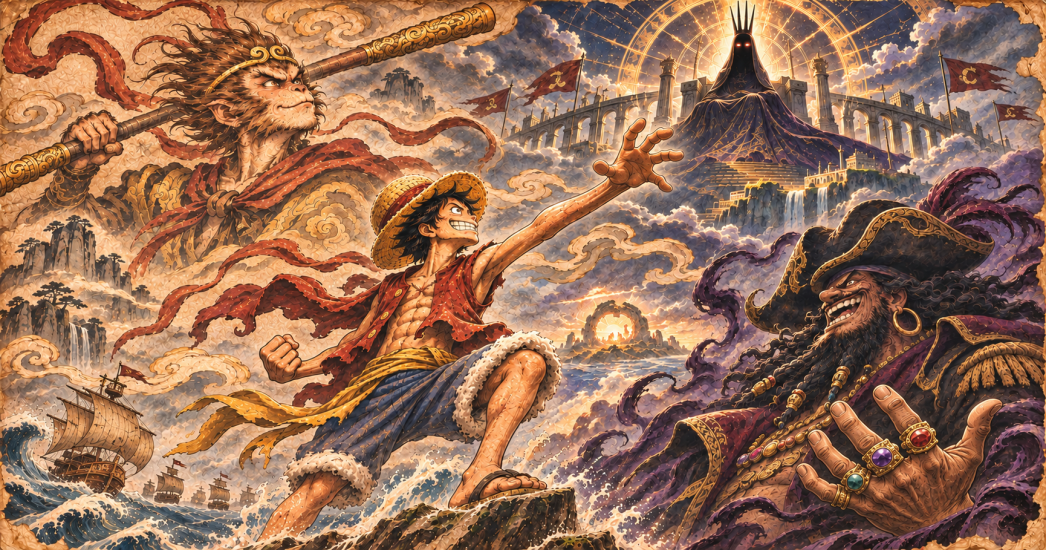
Why Monkey D. Luffy’s connection to Sun Wukong may explain the Straw Hats, the World Government, Imu, Blackbeard, and the final battle for freedom.
Spoiler warning: This analysis covers the One Piece manga through Chapter 1197, with a clearly labeled discussion of unconfirmed Chapter 1198 spoilers.
The Monkey King Was Hiding in Plain Sight
With reports that Luffy is developing a new ape-like transformation, fans are suddenly discussing whether Eiichiro Oda has turned the protagonist of One Piece into Sun Wukong, the legendary Monkey King from the Chinese classic Journey to the West.
But what if this isn’t a new direction?
What if Luffy has been built around the Monkey King archetype since the beginning?
Think about it.
Our protagonist is literally named Monkey. He’s a reckless, irreverent, food-obsessed troublemaker who accumulates extraordinary powers, gathers eccentric companions, crosses a fantastical world, defeats supernatural tyrants, and repeatedly challenges an established order that claims divine authority.
His enemies include celestial aristocrats, immortal rulers, supernatural creatures, and an increasingly literal hierarchy of gods.
And his ultimate goal isn’t wealth or domination. It’s freedom.
The resemblance to Sun Wukong is difficult to ignore.
But finding similarities is easy. The real challenge is determining whether they form a coherent narrative pattern, whether the differences undermine the theory, and whether the pattern can actually help predict what Oda is planning.
To investigate that, we need to compare the stories themselves, not just their main characters.
And the answer may be considerably stranger than Luffy simply becoming another version of Wukong.
1. The Original Journey to the West
Journey to the West is a sixteenth-century Chinese novel, traditionally attributed to Wu Cheng’en, that combines Buddhist philosophy, Daoist mythology, supernatural adventure, political satire, and comedy.
Its story can be divided into four broad stages.
First: The rebellion of the Monkey King.
Sun Wukong is born from stone, acquires supernatural abilities, and becomes extraordinarily powerful. Refusing to accept his place within the celestial hierarchy, he challenges Heaven, demands recognition, and declares himself the Great Sage Equal to Heaven.
His rebellion eventually forces divine intervention. The Buddha defeats him and imprisons him beneath a mountain for five hundred years.
Second: The formation of the pilgrimage.
The Buddhist monk Tang Sanzang, also called Tripitaka, is tasked with traveling west to India to retrieve sacred scriptures.
Wukong is released to accompany him, eventually joining other supernatural companions: the pig spirit Zhu Bajie, the river spirit Sha Wujing, and a dragon prince transformed into a white horse.
Third: The journey through monsters and false kingdoms.
The pilgrims encounter demons, corrupt rulers, illusions, supernatural traps, rival immortals, and monsters seeking the monk’s flesh.
Many episodes involve a supposedly legitimate authority turning out to be a disguised monster.
The pilgrims survive through cooperation, ingenuity, magic, and occasional assistance from higher spiritual powers.
Fourth: The scriptures and enlightenment.
After enduring eighty-one ordeals, the travelers obtain the scriptures and return home.
Their journey culminates not in overthrowing Heaven, but in spiritual transformation and recognition within the Buddhist cosmic order.
Wukong becomes the Victorious Fighting Buddha.
That ending is extremely important.
Because One Piece may be following a similar adventure structure while heading toward almost the opposite philosophical conclusion.
2. Mapping the Two Stories
The strongest comparison isn’t an exact correspondence between episodes. It’s the narrative machinery that connects them.
| Journey to the West | One Piece | Assessment |
|---|---|---|
| A rebellious monkey challenges the celestial hierarchy | Luffy repeatedly defies the Celestial Dragons and World Government | Strong thematic parallel |
| A supernatural traveler gains companions during an extended journey | Luffy recruits the Straw Hats across successive islands | Strong structural parallel |
| Demons and corrupt rulers control individual territories | Arlong, Crocodile, Enel, Doflamingo, Kaido, and others dominate local populations | Moderate structural parallel |
| Pilgrims travel to obtain sacred writings | Robin interprets Poneglyphs revealing the world’s forbidden history | Strong functional parallel |
| An impostor Monkey King challenges Wukong’s identity | Blackbeard represents an opposing path toward the same pirate dream | Suggestive, not literal |
| Heaven sends supernatural agents against the rebel | Admirals, God’s Knights, and the Five Elders defend the existing hierarchy | Strong institutional parallel |
| The pilgrimage ends with spiritual truth and cosmic recognition | Laugh Tale promises the truth of the Void Century and the One Piece | Strong thematic parallel; ending unknown |
However, there is a crucial chronological difference.
In Journey to the West, Wukong’s greatest rebellion against Heaven occurs before the pilgrimage.
In One Piece, the conflict with the world’s highest authority is intensifying near the apparent end of the journey.
That is a significant problem for a literal adaptation theory.
But it becomes fascinating if Oda is deliberately rearranging the myth.
Wukong begins as a rebel and eventually accepts enlightened discipline.
Luffy begins as an outlaw and may end by liberating the entire world from its divine rulers.
The two stories could be using similar building blocks to make opposite arguments about authority.
3. The Evidence Hidden in Luffy Himself
The name, personality, and powers
The name Monkey D. Luffy is the most obvious connection, but by itself it proves very little.
The stronger case comes from the combination of his personality, abilities, and relationship with authority.
Sun Wukong is playful, irreverent, impulsive, clever in unconventional ways, and extraordinarily difficult to control.
So is Luffy.
Both characters undermine powerful enemies through behavior their opponents consider ridiculous.
Both also reject rank as a sufficient reason to respect someone.
But their abilities offer more specific evidence.
Sun Wukong possesses a magical staff, the Ruyi Jingu Bang, which can change size. Luffy’s body stretches and expands, allowing him to achieve similar visual effects without carrying a staff.
Wukong possesses extraordinary transformations and can manipulate his appearance. Luffy’s Gear transformations increasingly allow extreme changes in shape, proportion, and physical behavior.
However, these abilities are not identical. Wukong’s transformations are learned magic, while Luffy’s powers come from a Devil Fruit.
And the fruit isn’t directly equivalent to the Peaches of Immortality. Wukong already possesses substantial supernatural abilities before stealing and eating the heavenly peaches.
That distinction matters because superficial similarity should not be mistaken for a shared origin story.
The attack names are much stronger evidence
Luffy’s Gear Fourth attacks include Kong Gun, whose Japanese writing evokes a monkey king.
Then, during the battle with Kaido, Luffy unveils Bajrang Gun.
This is particularly significant.
The Japanese writing of the attack means something close to Monkey God Gun, while Bajrang references Bajrangbali, another name associated with Hanuman, the divine monkey of the Hindu Ramayana.
Hanuman is itself a possible historical influence on the Monkey King tradition.
That gives us a much stronger connection than simply observing that both characters behave like monkeys.
Oda has deliberately incorporated divine-monkey imagery into Luffy’s combat vocabulary.
But it also introduces a competing explanation: Luffy might draw from several monkey-god traditions rather than Sun Wukong exclusively.
The headband and the straw hat
One of the most interesting comparisons is also a reversal.
Wukong wears a magical headband that Tang Sanzang can tighten through a prayer. It represents the discipline imposed on Wukong’s wild nature.
Luffy wears a straw hat entrusted to him by Shanks.
His hat represents a promise and an identity he willingly carries.
One headpiece helps control the monkey.
The other symbolizes the monkey’s chosen path.
This is an elegant literary inversion.
It is not evidence that Oda deliberately designed the straw hat as a response to Wukong’s headband. But if he did, the thematic contrast is remarkably appropriate.
A linguistic trap: Sun Wukong is not the Sun God
There is one popular argument that should be discarded.
Sun Wukong’s surname, 孫 (Sūn), does not mean the English word sun. It is associated with a Chinese word for monkey and carries meanings connected to descendants.
His given name, Wukong, refers to awakening to emptiness.
Therefore, the fact that Luffy possesses the powers of the Sun God Nika is not a linguistic confirmation that he is Sun Wukong.
The monkey connection is meaningful.
The English-language coincidence is not.
4. Are the Straw Hats the Other Pilgrims?
This is where the hypothesis gets considerably weaker if we demand exact character matches.
The original pilgrimage consists of a monk, three supernatural disciples, and a dragon horse.
The Straw Hats are a much larger ensemble, with independent ambitions and personalities that don’t fit neatly into those roles.
Still, several comparisons are worth exploring.
| Journey to the West character | Possible One Piece counterpart | Strength | Reasoning |
|---|---|---|---|
| Sun Wukong | Luffy | Strong | Monkey imagery, mischief, supernatural power, defiance of Heaven |
| Tang Sanzang / Tripitaka | Nico Robin | Moderate–strong | Retrieval and interpretation of sacred or forbidden writings |
| Zhu Bajie / Pigsy | Sanji | Moderate | Romantic obsession, exaggerated appetites and personality flaws, loyal companionship |
| Sha Wujing / Sandy | Jinbe | Moderate | Water-associated former outsider who becomes a disciplined, reliable companion |
| White Dragon Horse | Thousand Sunny / Going Merry | Weak–moderate | The indispensable vehicle carrying the party through its journey |
| Guanyin | Shanks / Rayleigh | Weak–moderate | Mentorship, protection, and helping set the hero on his path |
| Erlang Shen | Rob Lucci / Akainu | Moderate | Powerful enforcers of the established order |
| Jade Emperor | Imu | Strong institutionally | Supreme authority at the top of an elaborate celestial hierarchy |
| Six-Eared Macaque | Blackbeard | Moderate thematically | Rival claimant to the protagonist’s role and destiny |
Notice something important.
The better matches are not always personalities.
They’re narrative functions.
Robin is nothing like Tripitaka temperamentally. She is far more independent, knowledgeable, and capable of defending herself.
But in terms of what she contributes to the central quest, she may be the closest match in the entire Straw Hat crew.
Without Tripitaka, the sacred mission loses its purpose.
Without Robin’s ability to interpret the Poneglyphs, Luffy’s journey to Laugh Tale becomes substantially more difficult.
Likewise, Jinbe is not literally Sha Wujing. His relevance lies in the water connection, history of conflict, moral development, and stabilizing influence.
Sanji’s resemblance to Pigsy is more comedic. Both are defined partly by exaggerated romantic behavior, but Sanji is a cook who protects others from hunger, while Pigsy’s gluttony is one of his failings.
And several Straw Hats resist the comparison almost entirely.
Zoro, Nami, Usopp, Chopper, Franky, and Brook don’t possess convincing one-to-one counterparts in the original pilgrimage.
One could invent them, but doing so would weaken rather than strengthen the hypothesis.
The more defensible interpretation is that the Straw Hats collectively fulfill the functions of the original pilgrims, with Oda redistributing characteristics among a much larger cast.
5. Mapping the Villain Arcs
The same principle applies to the villains.
Journey to the West often introduces supernatural figures who control a region through intimidation, deception, or stolen authority.
The pilgrims expose the threat, defeat it, and continue their journey.
Sound familiar?
East Blue: The recruitment of the pilgrims
The East Blue saga establishes Luffy’s basic narrative pattern.
He encounters someone trapped by a seemingly inescapable situation, defeats the local authority responsible, and gains either an ally or a companion.
Zoro, Nami, Usopp, and Sanji join the journey through conflicts that establish their personal values.
This resembles the early formation of Tripitaka’s traveling party, although the individual recruitment stories differ substantially.
Alabasta: The hidden monster behind political disorder
Crocodile manipulates a kingdom toward civil war while publicly maintaining the appearance of legitimacy.
Journey to the West repeatedly uses disguised rulers and supernatural political manipulation.
The Lion-Lynx Demon, for example, impersonates the king of the Kingdom of Wuji.
The parallel is thematic rather than exact: a nation’s visible political crisis conceals a supernatural or powerful manipulator.
Skypiea: The Monkey challenges God
This is one of the strongest individual parallels in the entire series.
Enel declares himself a god, exercises extraordinary power, and punishes those who defy his authority.
Luffy ultimately defeats him.
The resemblance to Wukong’s rebellion against Heaven is striking.
Both stories derive comedy and dramatic satisfaction from a supposedly inferior troublemaker defying a being accustomed to obedience.
Yet Enel is a false god, not the legitimate ruler of Heaven.
That distinction may be important when comparing him with Imu later.
Water 7 and Enies Lobby: Open rebellion against Heaven’s bureaucracy
Here, the connection becomes even more pronounced.
The Straw Hats openly challenge the institutions of the World Government to rescue Robin.
The government claims overwhelming legitimacy. Its officials consider obedience mandatory.
Luffy refuses.
This is not merely a pirate breaking the law. It is a direct rejection of a system claiming the right to determine who deserves to exist and what history may be known.
Wukong’s battles with celestial officials similarly expose the limitations of authority when confronted with an adversary who refuses to recognize it.
Sabaody: Punching a Celestial Dragon
Perhaps no moment captures the Monkey King comparison more neatly.
A Celestial Dragon expects absolute deference based on birth and divine status.
Luffy punches him anyway.
The entire celestial hierarchy responds.
Wukong repeatedly provokes Heaven because he refuses to accept that heavenly rank automatically makes another being superior.
The thematic connection is unusually direct.
Impel Down: Reversing the imprisonment of the Monkey King
Wukong is imprisoned beneath a mountain after his rebellion.
Luffy voluntarily enters the World Government’s greatest prison to rescue Ace.
Rather than being broken by imprisonment, Luffy creates a massive disturbance and helps numerous prisoners escape.
This resembles the original myth in reverse.
The Monkey King is imprisoned to contain his rebellion.
Luffy invades imprisonment itself as an act of rebellion.
Dressrosa: The usurped kingdom
Doflamingo manipulates a kingdom, rewrites its collective understanding of reality, and maintains power through deception and terror.
This resembles the false-ruler episodes of Journey to the West.
It also establishes a recurring One Piece theme: an entire society can accept a false political reality when its ruling system controls knowledge and memory.
Whole Cake Island: The appetite of monsters
Big Mom rules a surreal kingdom organized around food, family, desire, and submission.
Thematically, this resembles the extravagant appetite and dangerous enchantment found throughout Journey to the West.
But the arc’s fairy-tale and Western literary influences are at least as obvious.
Trying to assign Big Mom to a particular character from the Chinese novel would be arbitrary.
Wano: The demon king and the liberated country
Kaido resembles the monstrous regional tyrants that the pilgrims defeat.
He is associated with dragons, overwhelming physical power, and a population trapped beneath his rule.
However, Wano provides an especially important alternative explanation.
Its plot also draws heavily on Momotaro, the Japanese story of the Peach Boy who travels with animal companions to defeat oni.
Momonosuke, Tama’s dumplings, Luffy’s monkey association, and Yamato’s wolf form reinforce that connection.
Even official One Piece commentary has discussed the Momotaro structure.
In other words, Luffy can occupy a monkey’s mythological role without that role necessarily coming from Sun Wukong.
Egghead: The forbidden knowledge
Egghead brings the question of truth to the center of the narrative.
The World Government’s opposition to forbidden historical knowledge, combined with Vegapunk’s discoveries and Robin’s ongoing mission, creates the closest functional analogy to the scriptures of Journey to the West.
But there is another inversion.
In the Chinese novel, the sacred scriptures are part of an authorized mission to spread religious knowledge.
In One Piece, discovering and spreading the world’s hidden truth threatens the established authorities themselves.
The knowledge serves liberation rather than the restoration of a recognized religious order.
Elbaph: Heaven comes down to fight the Monkey
By the Elbaph arc, the comparison is almost impossible to ignore.
The God’s Knights intervene directly in the affairs of another land.
Imu personally enters the battlefield.
The ruler who has been concealed above the world begins confronting the pirate who repeatedly destroys the legitimacy of divine authority.
Imu’s power to transform and dominate others through Domi Reversi makes the conflict especially relevant to a story concerned with free will.
But Elbaph also draws heavily from Norse mythology.
Loki, the giants, and the immense mythological tree imagery demonstrate again that Oda isn’t operating within a single mythological tradition.
The conclusion from the arc comparisons: The recurring pattern of a supernatural wanderer confronting corrupt rulers is real. Exact episode-to-episode adaptation is not established.
6. Imu: The Jade Emperor, a False Buddha, or Something Worse?
This is where the theory becomes most interesting.
In Journey to the West, the Jade Emperor presides over an enormous celestial bureaucracy.
Wukong’s refusal to recognize his place within that hierarchy creates chaos.
In One Piece, the Celestial Dragons occupy a supposedly sacred position above ordinary humanity.
The Five Elders operate as their highest visible rulers.
The God’s Knights serve as extraordinary enforcers.
And above them sits Imu.
Structurally, Imu resembles the supreme celestial sovereign.
But there is an important complication.
The Jade Emperor is not the ultimate evil of Journey to the West.
He represents cosmic administration and established authority. The Buddha ultimately stops Wukong’s rebellion, and the pilgrimage ends with Wukong obtaining enlightenment rather than overthrowing the heavenly order.
Imu, meanwhile, is increasingly depicted as a monstrous ruler exercising illegitimate control over the world.
That suggests Imu may combine several mythological roles.
The Jade Emperor’s institutional position: Imu sits at the top of a celestial hierarchy and commands extraordinary servants.
The false-divinity motif: Like the Yellow Brows Great King, who constructs a counterfeit sacred establishment in the original novel, Imu may represent a being falsely occupying the position of ultimate authority.
The demonic captor: Imu can rob opponents of agency, transforming them into monstrous instruments of someone else’s will.
The latest manga adds an especially important revelation.
Chapter 1179 identifies Nerona Imu as one of the founding Twenty and the King of the World, with a power captioned as the Devil’s Fruit.
We do not yet know the complete nature of that power.
But the symbolism is extraordinary.
Luffy’s awakened powers are associated with liberation, laughter, and an almost unrestricted ability to express himself.
Imu’s powers are associated with coercion, possession, demonic transformation, and submission.
That creates a conflict considerably larger than one pirate fighting one king.
It becomes a contest over the fundamental meaning of freedom.
My prediction: Imu will try to control the Monkey King
Recall Wukong’s magical headband.
It allows someone else to impose pain and discipline on a creature who refuses to be controlled.
Now consider Imu’s ability to dominate others.
What if the final confrontation includes an attempt to strip Luffy of his autonomy?
Not merely to defeat or kill him, but to turn the Warrior of Liberation into an obedient instrument.
Such a confrontation would reproduce one of the central tensions of Journey to the West, but potentially reverse its outcome.
Instead of accepting the controlling headband as necessary discipline, Luffy would reject the idea that any being possesses the authority to control another person’s will.
This is speculative, but thematically it is one of the strongest predictions generated by the comparison.
7. Blackbeard and the Six-Eared Macaque
Blackbeard may provide an even more consequential connection.
In Chapters 56–58 of Journey to the West, Wukong encounters the Six-Eared Macaque.
The creature impersonates him so convincingly that neither celestial nor earthly authorities can reliably distinguish the original from the impostor.
The conflict is about more than physical imitation.
It is a crisis of identity.
Two competing Monkey Kings appear, each claiming the position of the genuine pilgrim.
Now consider Marshall D. Teach.
From his earliest substantial interaction with Luffy on Jaya, Oda deliberately presents the two as opposing reflections.
They possess radically different tastes while sharing the conviction that dreams matter.
Both are pirates with the initial D.
Both aim toward the greatest prize in the pirate world.
Both gather unusual and dangerous companions.
But they embody fundamentally different approaches to ambition.
Luffy pursues freedom through friendship, trust, and voluntary loyalty.
Blackbeard pursues power through manipulation, betrayal, opportunism, and the exploitation of other people’s abilities.
One creates relationships that strengthen everyone involved.
The other repeatedly accumulates powers and people as resources to advance his ambitions.
The difference becomes particularly clear in their Devil Fruits.
Luffy’s Nika powers emphasize creative freedom and bodily transformation.
Blackbeard’s darkness can attract, absorb, and temporarily nullify other Devil Fruit powers on contact.
This creates a potentially decisive contrast.
Luffy represents the freedom to exercise extraordinary abilities. Blackbeard possesses an ability that can take that freedom away.
The Davy Jones revelation changes everything
The recent God Valley flashback adds a new dimension.
Rocks’s hidden name is revealed as Davy D. Xebec, linking his bloodline to the legendary Davy D. Jones.
Blackbeard is established as Rocks’s son and an inheritor of that lineage.
Even more importantly, Imu demonstrates a longstanding fear of both Davy Jones and Joy Boy.
This suggests that the final conflict does not simply involve one ancient rebel whose will has returned.
It involves at least two historical legacies that threaten the reigning order.
Luffy carries the powers and legacy associated with Joy Boy.
Blackbeard carries the bloodline associated with Davy D. Jones.
And Imu fears both.
That creates an extraordinarily compelling three-sided conflict.
| Figure | Possible endgame objective | Relationship to freedom |
|---|---|---|
| Luffy / Joy Boy | Reach the truth, become Pirate King, remove barriers to freedom | Freedom for himself and others |
| Blackbeard / Davy Jones | Claim the greatest power or status for himself | Freedom as the ability to dominate |
| Imu | Preserve the existing world order | Authority maintained through submission |
Blackbeard might therefore be neither a subordinate of Imu nor a conventional ally of Luffy.
He could be a rival claimant to the world Imu already controls.
His inherited history gives him a personal stake in destroying the existing order, but his methods and ambitions make him a potential replacement tyrant rather than a liberator.
Is Blackbeard literally the Six-Eared Macaque?
Probably not.
The Macaque copies Wukong’s appearance, voice, abilities, and position within the pilgrimage.
Blackbeard does not physically impersonate Luffy.
His similarities are ideological and structural.
A closer literal impersonator within One Piece would be someone like the fake Straw Hat captain Demaro Black.
But that character lacks Blackbeard’s thematic importance.
Blackbeard works better as a spiritual or narrative counterfeit: another bearer of inherited power and ambition who could claim the same ultimate prize while fundamentally misunderstanding what makes Luffy different.
That is a meaningful comparison, but not proof of a deliberate adaptation.
8. A Possible Three-Stage Endgame
If the comparison is useful, it should help us make predictions.
Here is one possible sequence, ranked by how strongly the existing story supports it.
Prediction 1: Luffy and Blackbeard will collide over the meaning of Pirate King
Confidence: High as a broad narrative expectation.
Both characters pursue the One Piece, and Oda has deliberately constructed them as ideological opposites.
Their confrontation should resolve more than who possesses superior Haki or Devil Fruit abilities.
It should test whether becoming Pirate King means possessing the power to control others or possessing the freedom to live without controlling them.
The original Six-Eared Macaque episode offers an interesting parallel because Wukong must defeat a rival version of himself before completing the pilgrimage.
This supports the possibility of Blackbeard’s decisive confrontation occurring before Luffy’s final reckoning with the world’s ruling order.
But it does not establish that sequence.
Prediction 2: Blackbeard will attempt to claim Imu’s position or power
Confidence: Moderate.
The Davy bloodline gives Blackbeard a direct historical connection to a figure Imu fears.
Blackbeard already pursues exceptional abilities and political leverage.
His darkness-based powers also make him unusually dangerous to Devil Fruit users.
If Imu’s power proves capable of being stolen or transferred, Blackbeard becomes an obvious candidate to attempt it.
This could produce an unexpected turn.
After Luffy weakens Imu, Blackbeard might try to seize the power or authority the hidden ruler possesses.
That would transform the final conflict from liberation versus tyranny into a contest over who controls the new world.
However, nothing has yet established that Imu’s power can actually be taken.
Prediction 3: The Straw Hats will discover the truth before the world’s political conflict is resolved
Confidence: Moderate–high.
In Journey to the West, obtaining the sacred scriptures is not exactly the final event. The pilgrims must still return and complete the consequences of their mission.
Likewise, reaching Laugh Tale may not conclude One Piece.
The Poneglyphs and Joy Boy’s legacy are intimately connected to the world’s political history.
Discovering the One Piece could provide the knowledge or means necessary to confront the existing world order.
In that structure, Laugh Tale would represent the completion of the pilgrimage, while the subsequent transformation of the world would serve as the story’s final act.
It is a structurally plausible prediction, though not one uniquely derived from the Chinese novel.
Prediction 4: Luffy’s ultimate victory will involve protecting his identity from an outside will
Confidence: Moderate.
This possibility becomes more interesting when considering the reported Chapter 1198 transformation.
Early leaks describe an unusually animalistic Luffy with dark hair, a tail, and fangs.
The reports also describe behavior that appears less conversational and more instinctive than Gear Five’s familiar laughter.
These details remain unconfirmed until publication.
If accurate, however, they raise an important question.
Is this merely another expression of Nika’s abilities, or does it reveal a tension between Luffy’s own identity and the nature of his awakened Zoan Fruit?
Zoan awakenings have already been associated with the possibility of the fruit’s nature overwhelming its user.
The Monkey King comparison suggests that Luffy’s ultimate test might not be the acquisition of more power.
It might be the preservation of his own will.
That would fit a story whose protagonist repeatedly insists on deciding how to live.
Prediction 5: Imu will lose the throne, but Luffy will refuse to occupy it
Confidence: High as a thematic prediction, lower as a specific plot outcome.
This is my strongest prediction about the philosophical ending.
Imu claims authority over the world.
Blackbeard may seek the same kind of supremacy.
Luffy has consistently rejected the idea that freedom requires ruling everyone else.
If Imu’s throne is destroyed, Luffy is unlikely to replace its occupant as a new absolute sovereign.
He would be much more likely to create the circumstances in which nobody can legitimately claim that position again.
That would be the final inversion of the Monkey King story.
Sun Wukong becomes recognized within the cosmic hierarchy.
Monkey D. Luffy makes the hierarchy itself unnecessary.
9. The Strongest Evidence Against the Theory
A good hypothesis needs more than supporting examples. It also needs to survive attempts to disprove it.
Here are the most consequential objections.
First, the philosophical endings are different. Wukong’s development involves discipline, Buddhist enlightenment, and spiritual transformation. Luffy’s development consistently emphasizes freedom, individuality, and loyalty without forced submission. The inversion hypothesis addresses this difference, but it cannot prove that the inversion is intentional.
Second, the chronology doesn’t match. Wukong confronts Heaven near the beginning of his story. Luffy’s conflict with the highest world authority escalates near the end. If this is a retelling, it is a heavily rearranged one.
Third, the characters don’t map cleanly. Robin, Sanji, and Jinbe possess partial functional parallels to Tripitaka, Pigsy, and Sandy, but the remaining Straw Hats do not reproduce the original pilgrims. Any claim that every crew member has an exact counterpart is unsupported.
Fourth, the villains are not unique to Journey to the West. False rulers, demon kings, kidnappings, supernatural trials, and oppressive governments are widespread storytelling traditions. Similarity alone cannot establish direct influence.
Fifth, other inspirations are demonstrably present. Wano incorporates Momotaro imagery. Elbaph uses Norse mythology. Bajrang Gun invokes Hanuman. Oda explicitly cited Tom and Jerry as an influence on Gear Five’s visual comedy.
Sixth, we lack direct author confirmation. Oda has not established that the entire structure of One Piece is an adaptation of Journey to the West. Even compelling parallels remain interpretations until supported by clearer evidence.
There is an additional caution: resemblance can become circular reasoning.
If Luffy defeats a ruler, we might call the ruler a demon king. If he meets a powerful warrior, we might call that warrior a heavenly general. If he befriends a glutton, we might call that character Pigsy.
Once every possible event can be explained as another correspondence, the hypothesis becomes impossible to falsify.
The solution is to prioritize specific, distinctive parallels, particularly those supported by explicit names, unusual narrative structures, and recurring symbolism.
10. What Would Actually Confirm This Interpretation?
Several future developments would significantly strengthen the theory.
A direct reference to Wukong’s titles, transformations, or recognizable implements would establish a much clearer connection than generic monkey imagery.
A Blackbeard confrontation explicitly focused on competing legitimacy, identity, or inheriting a heroic role would strengthen the Six-Eared Macaque analogy.
An attempt by Imu to impose absolute control over Luffy’s mind or transformed body would strengthen the headband inversion.
And an ending in which Luffy explicitly rejects the possibility of becoming a divine ruler would reinforce the interpretation that One Piece deliberately reverses the traditional Monkey King’s relationship with Heaven.
Conversely, the theory would weaken if the monkey transformation proves to be a short-lived visual gag, if Blackbeard’s story has no connection to the final question of world authority, or if the conclusion centers entirely on an unrelated mythology.
The important question is not whether Oda can include a Sun Wukong reference.
He obviously can.
The question is whether those references form an organizing principle of the entire narrative.
11. The Bigger Possibility: One Piece as a Mythological Synthesis
There is another explanation that may fit the evidence better than a direct Journey to the West adaptation.
Oda may be constructing a protagonist from several related mythological traditions.
Consider the influences already visible:
- Sun Wukong: The irreverent monkey who challenges Heaven.
- Hanuman: The divine monkey associated with immense size, strength, and the name Bajrang.
- Momotaro: The traveling hero who gathers companions and defeats oni.
- Dragon Ball’s Son Goku: A modern manga interpretation of the Monkey King archetype and an important influence on Oda’s generation.
- Western cartoon comedy: The exaggerated physical freedom and slapstick of Gear Five.
- Nika and Joy Boy: Oda’s own mythology of liberation, inherited will, and suppressed history.
Under this explanation, the correspondences aren’t evidence that One Piece secretly reproduces one older book.
They are evidence that Oda has assembled familiar mythological structures into something new.
The central theme connecting them is a character who defeats overwhelming authority through an unusual mixture of strength, innocence, laughter, and refusal to submit.
That explanation accommodates far more of the actual story.
It also avoids forcing every Straw Hat into a role they were never written to occupy.
Conclusion: The Monkey King Who Refuses to Be Tamed
The real question isn’t whether Luffy is turning into Sun Wukong.
The stronger question is whether Luffy has always represented a modern reinterpretation of the Monkey King.
The evidence for that broader connection is persuasive.
The name, personality, attack terminology, repeated challenges to celestial authority, supernatural companions, encounters with false rulers, and quest for hidden truth produce a recognizable pattern.
But the differences are just as important as the similarities.
Sun Wukong’s journey ultimately leads him toward enlightenment and a recognized position within the cosmic order.
Luffy’s journey may lead him toward dismantling the very idea that anyone should possess absolute authority over the world.
Imu represents the existing celestial hierarchy.
Blackbeard may represent someone determined to replace its ruler.
And Luffy represents the possibility that the throne itself should no longer exist.
That is why the recent revelations about Joy Boy, Davy Jones, and Imu matter so much.
They suggest the final conflict could involve three fundamentally incompatible responses to power: preserving it, seizing it, and liberating people from it.
If that is where Oda is heading, then the Monkey King parallels aren’t merely decorative mythology.
They are part of a much larger argument about freedom.
The original Monkey King challenged Heaven, was subdued, and eventually became part of the cosmic order.
Monkey D. Luffy may be the Monkey King who challenges Heaven, wins, and refuses the throne.
And if that’s the ending Oda has been building toward, then the biggest clue was never Gear Five, Nika, or a mysterious ape transformation.
It was the character’s entire philosophy from the very beginning.
Sources and Further Reading
This is a literary interpretation, not a statement of Oda’s confirmed intentions. The primary story references and additional research supporting this comparison include:
- One Piece — Official VIZ chapter archive, including Chapters 1044, 1048, 1159, 1164, 1179, and 1197.
- Journey to the West — Association for Asian Studies, an introduction to the novel’s structure, characters, and religious themes.
- Journey to the West — Chapter 58, the confrontation between Wukong and the Six-Eared Macaque.
- A Study of the Four Celestial Primates, Jim R. McClanahan’s research on the original mythological figures.
- Sun Wukong’s Surname and Its Connection to Daoist Doctrine, examining the linguistic and religious origin of his name.
- Eiichiro Oda and Gosho Aoyama’s 2022 interview, discussing the influence of Tom and Jerry on Gear Five.
- Official One Piece commentary on Wano’s Momotaro parallels.
- One Piece Chapter 1159 summary, documenting the Davy family revelations.
- One Piece Chapter 1164 summary, documenting Imu’s hostility toward the legacies of Davy Jones and Joy Boy.
- November 4, 2026 Chapter 1198 leak reporting, used only for the explicitly unconfirmed transformation discussion.